


Meaningful Tattoo Themes That Still Look Strong

A tattoo can carry a whole life story, but it only gets one first read from across the room. The best meaningful tattoo themes do both: they mean something specific to you and hold up as clear, confident designs on skin. That second part matters. A powerful idea deserves more than a tiny symbol that turns muddy or a trendy reference that stops feeling like you five years from now.
Meaning is personal. Strong tattooing is craft. Bring both into the room, and you have a better chance of leaving with work you will be proud to wear for decades.
Start With the Story, Not the Search Results
People often begin by looking for a symbol that represents a feeling: strength, grief, freedom, love, change. There is nothing wrong with inspiration, but broad meanings can lead to generic tattoos if the connection stops there. A better starting point is a real detail.
Instead of asking, “What tattoo means resilience?” ask what resilience looked like in your life. Maybe it was the dog that got you through a hard year, the toolbox you inherited, a specific wildflower from a family trip, or a matchbook from the first place you felt at home. Those details give an artist something real to build from.
The story does not need to be dramatic to deserve a tattoo. A good life is full of small, lasting things: a favorite meal shared with someone you miss, a job you worked hard to earn, a place that changed your direction, a promise you kept to yourself. The personal connection is what gives the image its weight.
You do not need to explain every layer to everyone who asks about it, either. Some tattoos are conversation starters. Some are private markers. Both are valid.
Meaningful Tattoo Themes With Real Staying Power
Certain themes return again and again because they leave room for a personal story while offering strong visual material. The goal is not to copy a stock design. It is to recognize which direction feels true, then make it yours.
Family, Roots, and Home
Family tattoos do not have to be names and dates, though a name can be right when it is handled with care. Think about objects, places, or rituals that make your family recognizable to you. A worn recipe card, a particular bird from your grandparents' yard, a house key, a lucky playing card, or a piece of fruit from a childhood tree can say more than a literal portrait.
For people with roots in more than one place, a tattoo can also honor the road between them. That might be a regional plant, a local landmark simplified into a bold shape, or an object tied to a family trade. Be thoughtful when working with cultural symbols. If an image belongs to a living tradition you are not part of, choose something from your own experience instead of treating it as decoration.
Love, Friendship, and Chosen Family
A tattoo for another person does not need to be their face or their handwriting. Sometimes the strongest tribute is an image connected to a shared joke, a road trip, a song title, or a habit only the two of you understood.
Matching tattoos can work beautifully when each tattoo also stands on its own. The same design on two people may feel meaningful now, but a slightly different take on a shared subject often has more longevity. Two friends might each get a different hand in the same card game, or two siblings might choose different flowers from the same garden.
Change, Recovery, and Personal Milestones
Big transitions are common reasons to get tattooed: getting sober, ending a long chapter, becoming a parent, moving somewhere new, surviving illness, or finally choosing a different path. The trap is reaching immediately for the most obvious visual shorthand.
A better question is: what image feels like the moment after the change? Maybe it is a healed-over dagger, a ship with a full sail, a hand holding a lit match, a snake shedding its skin, or a flowering branch after a long winter. Traditional tattoo imagery has lasted because it can carry several meanings at once. A panther can be protection, survival, power, or simply a panther that looks great. That flexibility is a feature, not a weakness.
Time, Memory, and People You Miss
Memorial tattoos carry a lot of responsibility. Give yourself room to decide what you want the tattoo to do. Should it bring back a person’s humor? Mark a date? Keep an object close? Honor the way they lived?
Photorealistic portraits are one option, but they are not the only serious option. A favorite cigarette case, fishing lure, garden glove, coffee mug, pair of dice, or old work boot may hold a sharper memory than a face. For dates and lettering, prioritize legibility. Fine lines and tiny type can fade together over time, especially in high-wear spots such as fingers, feet, and hands.
Place, Travel, and Belonging
A location can matter because it is where you grew up, where you started over, or where you learned who you were. You do not need a literal map to honor it. A street sign, a local animal, a skyline detail, a familiar bridge shape, or a piece of everyday architecture can make a better tattoo than a pin on a map.
For Bay Area clients, the places around Oakland can be part of a personal story without becoming a souvenir design. A view you took on every commute, a flower from a neighborhood sidewalk, or an old sign from a meaningful block has more character than a generic outline of California.
Values You Want to Carry
Some themes are less about a single event and more about the person you are trying to be. Courage, discipline, tenderness, luck, curiosity, faith, and independence can all make good tattoo territory. Still, values need an image that can stand on its own.
That could mean a sturdy anchor for steadiness, a torch for commitment, a swallow for return, a rose for devotion, or a watchful animal for protection. These motifs have history, but your color choices, placement, surrounding elements, and personal associations make them individual. There is no prize for choosing an obscure symbol if a classic image says what you mean with more force.
Let the Design Carry Its Own Weight
A meaningful concept is not automatically a tattoo design. Skin changes, bodies move, and details need room. The design has to work at the size and placement you choose.
This is where people often make a trade-off. A small tattoo can be subtle, but it cannot hold a crowded story forever. A larger piece can include more detail and age more clearly, but it asks for more visibility, time, and commitment. Neither choice is better across the board. The right choice depends on your idea, your comfort with visibility, and the part of the body you are working with.
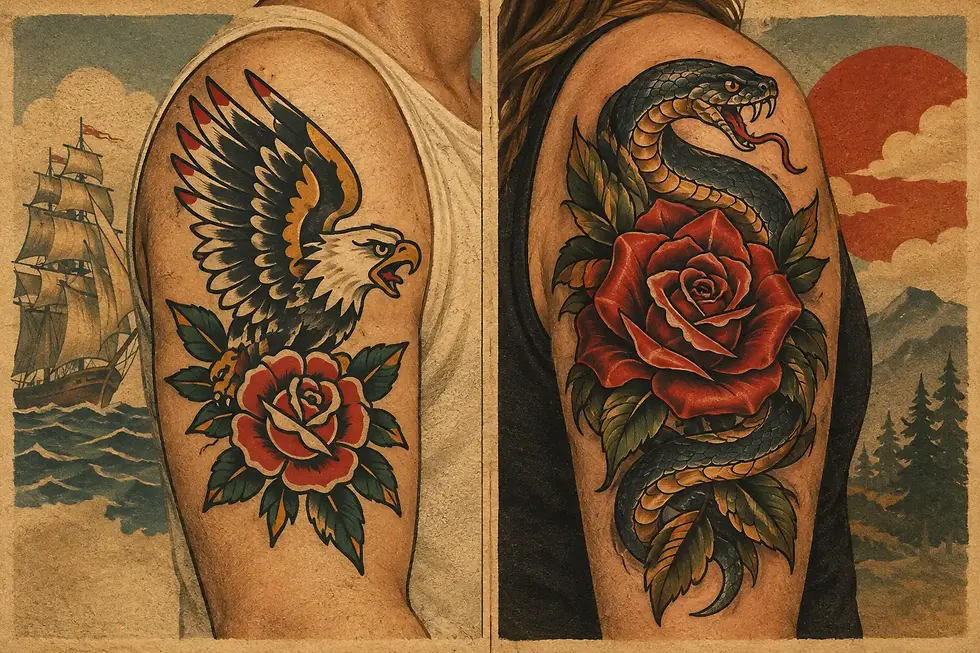
Traditional tattooing offers a useful standard: strong outlines, readable shapes, solid contrast, and color or black that stays clear. You can bring in a highly personal subject and still let it be bold. A delicate item can become a clean emblem. A complicated memory can become one central image with a few supporting details, rather than a collage trying to explain everything at once.
When choosing placement, think beyond the first photo. How will the tattoo read from a few feet away? Will clothing rub against it? Does the area receive heavy sun? Is it likely to distort with movement? Your artist can help you make those calls, but it helps to arrive ready to discuss what matters most: scale, visibility, detail, or speed of healing.
Work With an Artist, Not a Template
The strongest custom tattoos usually begin with a clear brief and enough room for the artist to do their job. Bring reference images for mood, shape, color, and subject matter, but do not expect a direct copy of someone else’s tattoo. Good reference tells an artist what you respond to. It should not limit them to recreating somebody else’s work.
Be direct about the non-negotiables. If a flower must be a marigold because of who it represents, say so. If you want bright color, say so. If you need the design to fit around existing work, bring clear photos and measurements. Then listen when the artist recommends simplifying an element, changing the angle, or sizing it up. Those choices are often what keep a good idea from becoming a hard-to-read tattoo.
Look closely at portfolios for the kind of work you want. If you love bold traditional designs, choose an artist whose lines, color, and compositions already show that strength. At Good Tattoo, the point is not to force every idea into one look. It is to build a design that feels personal and reads like a tattoo from day one.
Give the Idea Time Before You Commit
Not every meaningful tattoo needs a long waiting period, but a little distance can clarify the design. Save the idea, sketch it badly in your notes, say it out loud, and see whether the story still feels honest after a few weeks. If it does, you are probably onto something.
Then bring the real version of that story to the appointment. A good artist can turn one small, specific memory into a bold piece of work that stays with you for the right reasons.


Comments