


How to Find Tattoo Inspiration That Lasts

A tattoo can begin with a flash of recognition: a panther that stops you in your tracks, a flower you keep noticing, a phrase that has stayed with you for years. The harder part is knowing whether that feeling will hold up after the first rush. Learning how to find tattoo inspiration is less about scrolling until something looks cool and more about paying attention to what already has a place in your life.
A strong tattoo does not need a complicated backstory. It does need a reason to belong on your body. That reason might be personal, visual, funny, sentimental, or simply that the design has real staying power. Start there.
Start with what you come back to
The best tattoo ideas tend to repeat themselves. Think about the images, objects, animals, places, and symbols you have been drawn to over time. Maybe you have collected old matchbooks, always wear the same piece of jewelry, love western art, keep a certain plant alive, or cannot stop looking at ships, snakes, swallows, or roses.
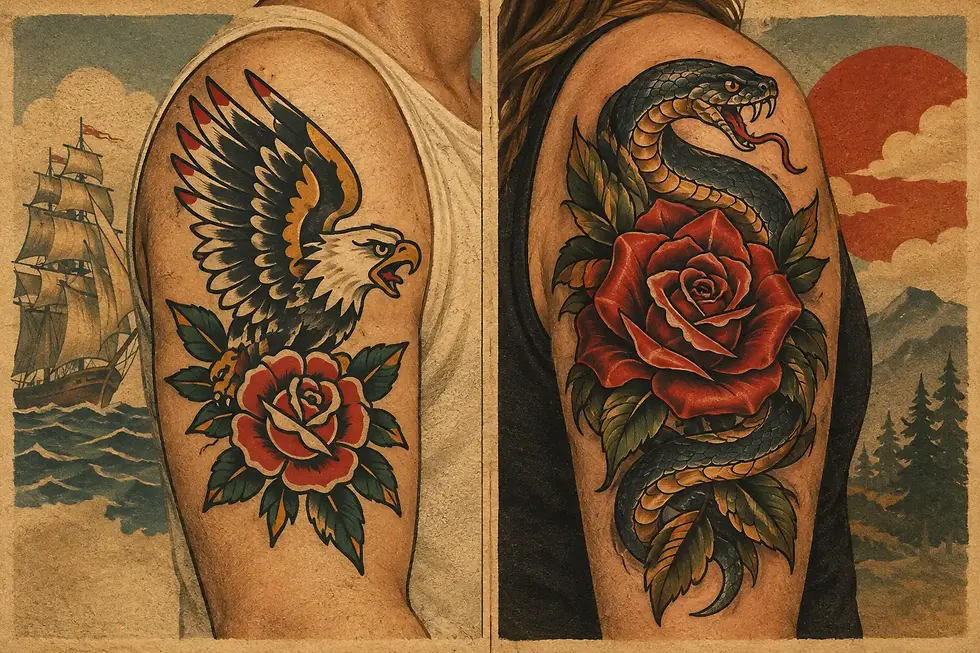
This is useful because repetition cuts through the pressure to invent a perfect, never-before-seen concept. A tattoo does not have to explain your whole personality. It can mark one thing you genuinely like. Traditional tattooing has lasted in part because it understands this: a good subject, drawn with conviction, does not need an elaborate pitch.
Try keeping a running note on your phone for a few weeks. Add ideas when they occur naturally, rather than sitting down and demanding inspiration on command. Write down the image and a sentence about why it caught your attention. Patterns will show up quickly.
Look beyond tattoo images
Tattoo references are helpful, but they should not be your only source. If every reference comes from social media, it is easy to end up with a tattoo that feels borrowed from someone else's collection. Look at the things that formed your taste before you decided to get tattooed.
Old books, record sleeves, family photographs, signage, travel ephemera, botanical illustrations, vintage packaging, sports graphics, folk art, film stills, and objects around your home can all point toward a better idea. You are not looking for a design to copy exactly. You are gathering a visual language.
For example, a photo of your grandfather's fishing tackle might lead to a custom lure, a fish, or a small scene with the right mood. A favorite neighborhood sign might suggest a lettering style rather than becoming a literal replica. A handful of references gives an artist material to work with while leaving room for an actual tattoo design.
Build a reference folder with a point of view
Save images that share an energy, even if they are not all tattoo-related. Notice the common threads. Are you consistently choosing bright color, black and gray, clean symmetry, dense detail, playful characters, strong outlines, or hand-painted lettering?
A good reference folder is edited. Twenty images that show a clear direction are more useful than 300 screenshots with no connection. Include a few tattoos you like for placement or style, then balance them with source material that makes the idea yours.
If you are bringing reference to a consultation, be clear about what you respond to in each image. Say, “I like the shape of this,” “I want this color feeling,” or “I like how simple this reads from across the room.” That is far more helpful than asking for an exact copy.
Choose a subject before chasing a style
Style matters, but it works best when it serves a solid subject. A skull, tiger, dagger, heart, eagle, fruit, candle, portrait, or flower can take on very different personalities depending on how it is drawn. Start by deciding what you want to wear. Then look for the artist whose approach makes that subject feel right.
This order also keeps you from forcing an idea into a style that does not suit it. Some concepts need bold, simple shapes to read clearly. Others benefit from fine detail or a larger composition. The goal is not to squeeze every idea into one tattoo. The goal is to make one good tattoo at a time.
For a first tattoo, simplicity is often an advantage. A clear design with room to breathe will usually age better than a tiny image loaded with detail. Small tattoos can be great, but small is not the same as cramped. Your artist can tell you when an element needs to be larger, bolder, or left out entirely.
Think about placement early
Placement changes the design. A tattoo that looks great on a flat screen may need to curve, lengthen, simplify, or turn to work on a forearm, calf, shoulder, thigh, chest, or hand.
Ask yourself what role you want the tattoo to play. Do you want to see it every day? Do you want it visible at work, easy to cover, or part of a larger collection? A visible spot can make a simple idea feel more intentional. A larger area can give an artist room to make a design breathe.
It is also worth thinking about your existing tattoos. You do not need a full master plan, but a little awareness helps. If you expect to add more work over time, leave enough space for future pieces and consider how the new tattoo will sit beside what is already there. A good artist will think about flow, spacing, and the body as part of the design.
Let the right artist shape the idea
The right tattoo is a collaboration, not a design contest. You bring the subject, references, placement, and non-negotiables. The artist brings experience with drawing, composition, skin, and what will still look strong years from now.
Look closely at portfolios. Do not only search for a tattoo that matches your exact idea. Look for consistency. Are the lines confident? Does the color look clear? Are the designs readable from a distance? Do healed tattoos hold their shape? Most of all, do you like the way that artist handles the kind of image you want?
An artist may suggest changing scale, removing a detail, shifting placement, or choosing a different composition. That is not a failure of your idea. It is often how a promising idea becomes a tattoo that works. The best custom work leaves room for professional judgment.
Know when flash is the answer
Not every tattoo needs to be custom. Flash exists because certain designs are already strong, balanced, and ready to tattoo. Choosing flash can be a direct, confident move, especially when you want something timeless and do not need every inch of it to be symbolic.
Walk-in tattoos are especially good for this. You may come in thinking you need a fully formed concept and leave with a design you had not considered, but immediately knew was right. Keep an open mind, while still respecting your own taste. The right spontaneous tattoo should feel exciting, not like a compromise.
Give the idea a little time
You do not need to wait five years for every tattoo. Some of the best ones happen on a good afternoon. But if you are stuck, give yourself a simple test: keep the idea in your reference folder for a month without actively searching for replacements. If you are still thinking about it, it has earned more attention.
This is especially helpful with designs tied to a fast-moving trend. Trend-driven tattoos are not automatically bad. The question is whether you like the image itself or only the moment around it. If the trend disappeared tomorrow, would you still want it on your skin?
There is no prize for making a tattoo more serious than it needs to be. A tattoo can honor a person, a memory, or a major turning point. It can also be a bright, tough-looking frog because you like frogs. Both can be great choices when the design is strong and the decision is yours.
Bring a clear brief, not a finished drawing
When you are ready to reach out, keep your request straightforward. Share the subject, preferred placement, approximate size, style direction, and a few references. Mention anything that must be included and anything you definitely do not want. If you have flexibility, say so.
Avoid micromanaging every line before the artist has had a chance to draw. A tattoo is not a logo review. It is a piece of work made for a moving, changing body. The clearer you are about the feeling and the essentials, the more freedom there is to make the final design better.
At Good Tattoo, that can mean choosing an artist whose portfolio already speaks to you, bringing your best references, and trusting the process enough to let the drawing become a tattoo. Good work starts with a good idea, but it gets there through good decisions.
The idea does not have to be profound. It just has to keep its grip on you. Pay attention to what you return to, choose an artist whose work you trust, and give the final design enough room to be bold on purpose.


Comments